
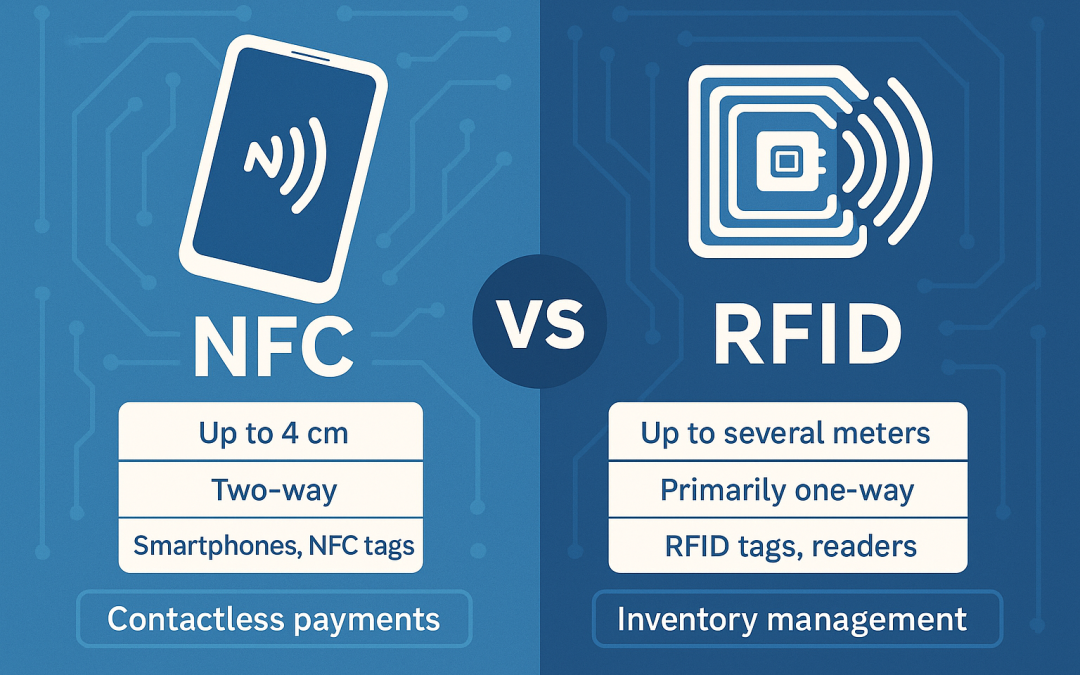
NFC VS RFID
In the fast-paced world of modern commerce, Near Field Communication (NFC) and Radio Frequency Identification (RFID) have become crucial technologies for optimizing business operations. While both enable wireless data transfer, their unique features make them suited for different commercial applications. This article helps commercial merchants understand the differences between NFC and RFID and decide which technology better meets their business needs.
Understanding NFC
NFC is a short-range communication technology that allows devices to exchange data within a distance of about 4 centimeters. Typically embedded in smartphones, NFC supports seamless contactless payments, data sharing, and device pairing. Its user-friendly nature and robust security make it ideal for consumer-facing applications.
Key Characteristics of NFC:
– Short Range: Operates within a 4 cm radius.
– Two-Way Communication: Allows both devices to send and receive data.
– Secure and Convenient: Primarily used for mobile payments, customer loyalty programs, and data sharing.
– Device Requirements: Typically requires active electronic devices, such as smartphones or NFC tags.
Understanding RFID
RFID technology uses radio waves to automatically identify and track objects. Widely used in inventory management, logistics, and access control, RFID is available in three types: Low Frequency (LF), High Frequency (HF), and Ultra-High Frequency (UHF), each catering to specific commercial uses.
Key Characteristics of RFID:
– Longer Range: Can operate from a few centimeters to several meters, depending on frequency.
– One-Way or Two-Way Communication: Primarily used for identifying objects rather than exchanging data between devices.
– Versatility: Suitable for inventory management, asset tracking, and supply chain logistics.
– Passive and Active Tags: Passive tags draw power from the reader, while active tags have their own power source.
NFC vs RFID: A Comparison
| Feature | NFC | RFID |
| Communication Range | Up to 4 cm | Up to several meters |
| Data Exchange | Two-way | Primarily one-way |
| Device Type | Smartphones, NFC tags | RFID tags (passive/active), readers |
| Common Applications | Contactless payments, loyalty | Inventory management, asset tracking |
| Power Requirements | Generally active devices | Passive or active |
Challenges and Considerations
For commercial merchants, NFC’s short range is an advantage when security is essential, such as during contactless payments. However, this same feature limits its use to close-proximity interactions. RFID, with its extended range, is more suitable for managing inventory and tracking assets but may face interference and privacy issues.
Choosing the Right Technology
When selecting between NFC and RFID, consider your business requirements. If secure, short-range transactions are a priority, NFC is the better choice. On the other hand, if your business needs efficient asset tracking and inventory management, RFID stands out. By assessing your commercial needs, you can implement the most suitable technology for optimal results.
Conclusion
Both NFC and RFID offer distinct benefits that can significantly impact business efficiency. Commercial merchants should evaluate their specific needs to choose the most appropriate solution, whether for customer engagement through NFC or streamlined logistics via RFID.
If you’d like to learn more about how these technologies can benefit your business, reach out to ERGT IT Advisor for a complimentary one-hour consultation. Contact us at +6012-7288006 or via email at admin@ergrouptech.com.


