
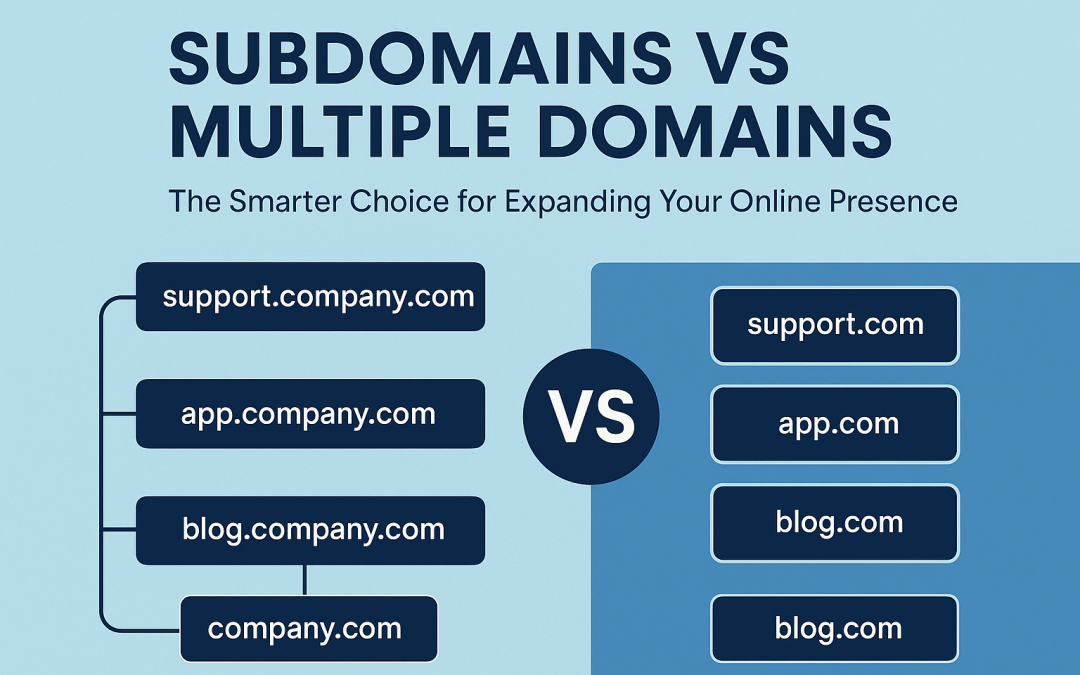
Subdomains VS Multiple Domains
The Smarter Choice for Expanding Your Online Presence
When companies develop new systems or applications, they often face the choice between creating entirely new domains or using subdomains under an existing primary domain. More often than not, companies choose subdomains. This strategic decision offers a multitude of benefits, ranging from technical simplicity to brand consistency. In this article, we explore why subdomains are the preferred option.
1. Branding and Consistency
One of the most compelling reasons to use subdomains is the ability to maintain brand consistency. Subdomains allow businesses to clearly identify that a new system or app is part of the same organizational ecosystem. For example, having support.company.com, app.company.com, and blog.company.com immediately signals to users that these systems are part of the same brand. This consistency helps build trust and familiarity.
2. Cost Efficiency and Maintenance
Managing a single primary domain with multiple subdomains is far more cost-effective than registering and maintaining multiple domains. Domain registration fees, SSL certificates, and renewal costs can add up quickly if each system requires a separate domain. Subdomains, on the other hand, often fall under a single certificate and are easier to manage collectively.
3. Improved SEO and Online Presence
Search engines typically view subdomains as part of the primary domain, which means that the authority and trust established by the main domain can extend to its subdomains. This interconnectedness aids in maintaining a unified online presence, making it easier to optimize SEO strategies. Conversely, multiple domains dilute authority and can fragment SEO efforts.
4. Ease of Technical Management
IT teams often find it simpler to manage subdomains because they share the same DNS settings as the primary domain. Changes and updates can be rolled out consistently, reducing the risk of configuration errors. Additionally, subdomains make it easier to integrate apps and services under a single authentication system, such as Single Sign-On (SSO), enhancing the user experience.
5. Flexibility and Scalability
Subdomains offer flexibility in creating environments for different purposes, such as development, testing, and production (dev.company.com, test.company.com). This segregation allows developers to experiment without impacting the primary site. As companies scale and introduce new services, they can seamlessly add more subdomains without the hassle of purchasing new domains.
6. Enhanced Security and Isolation
By isolating different systems within subdomains, companies can improve security management. A breach in one subdomain does not directly affect others, unlike managing a monolithic system under a single domain. Subdomains also allow for the use of specialized SSL certificates and separate security policies as needed.
Conclusion
Choosing subdomains over multiple domains offers practical, technical, and financial advantages for businesses looking to expand their online services. From maintaining brand cohesion to enhancing security and management efficiency, subdomains prove to be a smarter choice for most modern enterprises.


